Case study // Jamie Warren
Wall & Partition Assembly
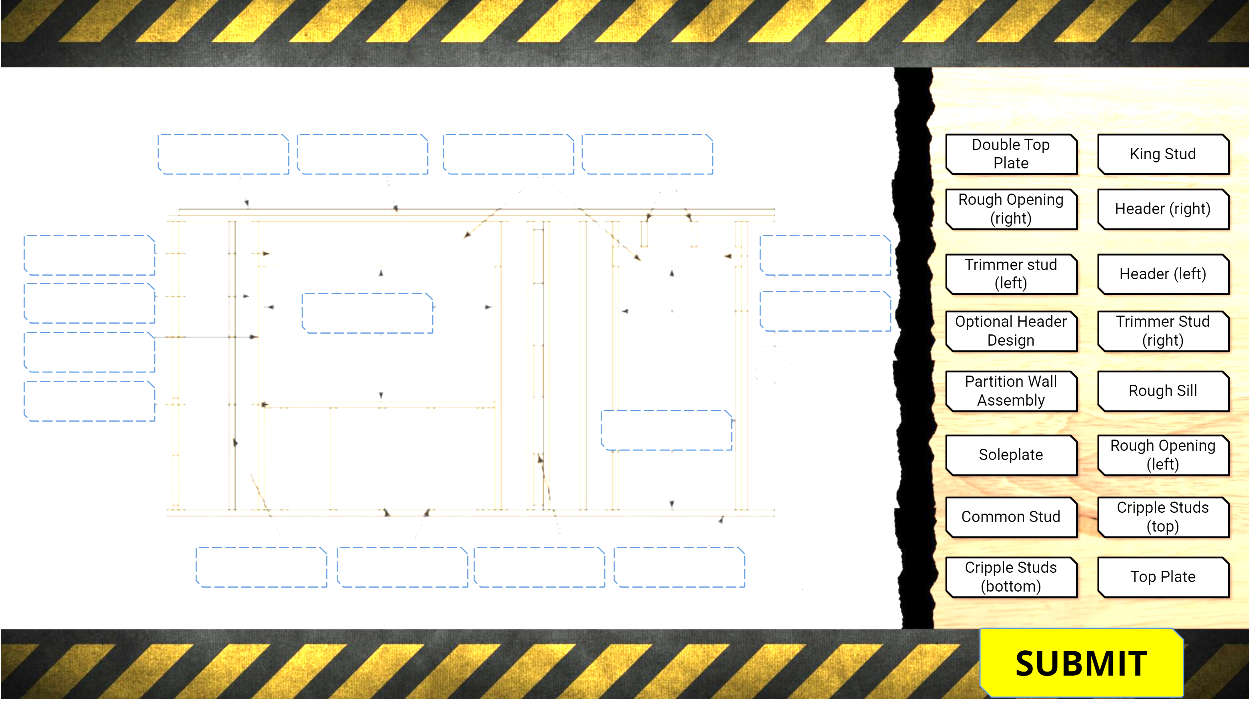
An instructor teaching blueprint reading and construction came to the Teaching & Learning Center wanting interactives for his course. This Storyline drag-and-drop — label every component of a wall assembly before you can submit — anchored that commission.
At a Glance
| Role | Designer and developer; commissioned build for CTE faculty |
| Context | Blueprint reading & construction course, Blue Ridge Community College; delivered alongside a set of H5P activities for the same instructor |
| Timeline | Built and published February 2024 |
| Tools | Articulate Storyline 360 — drag-and-drop labeling with submit-gated validation; custom background composition |
| Artifact | View the interaction |
The Problem
Reading a blueprint means seeing a wall the way a framer does: top plate, studs, headers, the named anatomy under the drywall. It’s an identification skill, and the textbook version — a labeled diagram to memorize — tests recognition, not recall. The instructor wanted students producing the names, not nodding at them.
Constraints
- Complete-before-submit — the interaction had to demand a full answer, not reward one-label-at-a-time trial and error
- Faithful to the trade — component names and placements had to survive review by an instructor who frames walls for a living
- Part of a package — one commission, multiple artifacts; the Storyline piece had to coexist with H5P activities in the same course economy
The Approach
The core design decision is the submission gate: every label must be placed before submit unlocks. That’s a deliberate choice between feedback philosophies, and it was the decision I wrestled with most. Immediate per-drop feedback lets students guess their way through — drop, check, adjust — without ever holding the whole wall in their head. Gating validation behind complete placement forces a committed mental model first; the red flags on wrong answers arrive only after the student has answered everything. It trades comfort for recall practice, which is the point.
This was also the project where I learned Storyline’s drag-and-drop logic from the inside — drop-target states, submit-triggered evaluation, the distance between how the interaction should behave pedagogically and how the tool wants to behave by default. The visual layer is a custom background composed outside Storyline with the interaction built over it.
(Pending: exact feedback/retry configuration — being verified against the published package rather than trusted to memory.)
The Result
Two years after delivery, the interaction is still in active use — course records for the 2024–2026 construction sections show students working it as recently as the final week of Spring 2026 classes. Instructors quietly retire activities that don’t earn their place; surviving across sections for two years is its own adoption metric.
Looking Back
Here’s the uncomfortable part: until recently, I didn’t know any of that. I delivered the piece in 2024 and the feedback loop simply ended — no usage data reached me, no follow-up was built into the handoff, and for two years I half-assumed it had died on the vine. It hadn’t. But finding out by accident is not a process. Delivery is not implementation, and implementation is not evaluation. Every commission I take now builds the follow-through in from the start: who places it in the course, when we check usage, and how I’ll hear whether it worked. The documented adoption in my later pipelines is a direct response to the two years this one spent succeeding in silence.
Artifacts
- Wall & Partition Assembly — live review link
- Related: Moodle Lessons → SCORM — the pipeline this kind of interaction plugs into